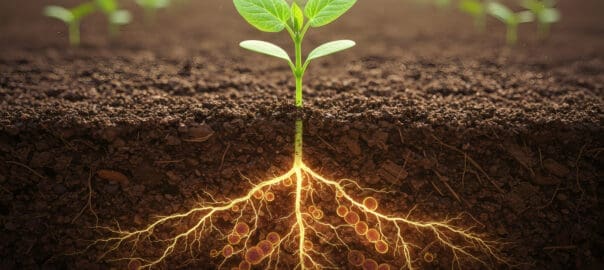

What is bio-habitat. It is a microscopic, crystallized, lattice-like structure that guarantees sustainable aerobic soil conditions ideal for proper air and water infiltration. Air and water is fundamental to fuel the carbon cycles required for humification. Bio-CHAR is an excellent, commercially available soil amendment, ideal for utilization in bio-habitat formation. Once in the soil, the physical, microscopic lattice-like structural habitat is very durable, lasting for many decades, maybe longer. In addition, biochar delivers numerous other beneficial soil amended characterists result such as increased drought tolerance, greater air and water infiltration and improved nutrient mobility, just to name a few. Sub-terrestrial organic residue digestion, absent the presence of carbon rich bio-habitat, cannot take place without effecient, effective, microbial “life-cycling”.
Carbon is an essential part of ALL life found within our vast eco-system and shapes the framework for ALL organic molecules. The fusion of Carbon and Organic Matter results in an energy explosion tantamount to a total of all the atomic bomb explosions ever made. This remarkable phenonomon is know as Carbon Fixation. In simple terms, this process drives reactions that form organic compounds such as starch and sugars from the simple molecules of carbon dioxide and water. Starch, a polysaccharide, subsequently acts as the basic energy reserve in plant cells.
Carbon plays a key role in plant respiration, decomposition and photosynthesis. Without Carbon, photosynthetic impoundment of the suns energy and sustainable bio-fertility could not effectively fuel both microorganism ‘life cycling’ and plant respiration.
Soil microorganisms perform many activites and contribute greatly to our ecosystem. The fertility level of the soil depends almost exclusively on microorganisms. Remarkably, one gram of soil can contain as many as 100,000 microorganisms. There are 4 major types of microorganisms: Bacteria, Fungal, Algae and Actinomycetes. Organic matter does NOT decompose efficiently without the presence of microorganism colonization. Poor microorganism colinization most often results in incomplete organic matter digestion. This leads to anaerobic root-zone conditions that often preceeds the development of soil borne pathogens. Most importantly, microorganism colinization can not flourish without Carbon – Food and Habitat. Microorganism energy explosion resulting from “Life Cycling” ranges from 20 minutes to a few hours.
Optimal soil fertility is achievable
in a number of ways.
Hands down, natural, eco-sensitive
and sustainable soil biofertility
is the ultimate achievable
objective. Below are the
fundamentals required to get
to sustainable soil bio-fertility.
1. You will require good biohabitat
for microorganisms to
colonize. To achieve this, you
will want to consider bio-char
and/or calcined diatomaceous
earth diatoms. Amend your
soils and ‘check-off’ the microorganism
habitat requirement.
2. Carbon is necesary, which is
why most choose bio-char to
fulfill both carbon and habitat
requirements simultaneously.
3. Use BioPlex microorganism
soil and root inoculants
will ‘populate’ the colinization
process.
4. Organic feeder substrates
found in compost provides
humate substrates microorganisms
can digest to fuel their
initial ‘life-cycling’ process.

During their life cycle, all living soilborne microorganisms experience a certain period of growth and then all of them complete their inevitable ‘end of life cycle’ and eventually die. After death, the actual physical remains (organic residue) of the dead organisms continue to experience dynamic and intense transformations, ultimately resulting in minerialization (plant food). Biochemicals and thermodynamics are at the core of this regenerative, complex “Life and Death Cycling” process. The final result is a more extended natural menu that manifests itself in the form of complex polymers of carbohydrates, proteins, lignins, lipids, tannin, polyphenols and other organic compound segments.
Microbial residents find a source of energy and food value for their metabolic survival through the biochemical transformation of a large and diverse menu of “Carbonaceous Compounds”. This process is ‘humification’, where complex polymers found in dead, degraded plant tissues, with the help of enzymatic actions, are further disintegrated into simpler, more fundamental compounds. This regenerative process of biochemical transformation releases a secondary sub-set of mineralized elements with additional nutrient value (plant food) that also includes captured atmospheric nitrogen.
Long term uninterrupted nutrient availability is achieved from this self sustaining “Life and Death Cycling” process. As a direct result of microbial Life Cycling, an organic bio-mass residue is created and is subsequently degraded thru additional intense transformation that ends with additional mineralization – and so the “Life Cycling” process repeats itself all over again, and again, and again, until such time organic food substrates are depleted. This pro-life support phenomenon, where “life itself ends in death and death leads to life” is inextricably linked to a carbon based bio-habitat located within the root rhizosphere and surrounding soils. This complex cycling process, results in a natural ‘smorgasbord’ that Mother Nature ultimately provides as a menu to nourish all life that comes to her table.
The fertility of our soil is HEAVILY dependent on regenerative microbial cycling activity that is HEAVILY dependent on diverse Carbonaceous Substances. As important as carbon is to this process, optimized PLANT HEALTH is not sustainable without a healthy rhizosphere rich in ORGANIC FOOD SUBSTRATES, AMINO ACID, FULVIC ACID, BENEFICIAL FUNGI and other organic compound segments.
Sustainable bio-fertility is about invisible, subterrestrial symbiotic relationships that repopulate themselves by the billions of times each day. Fundamental to these regenerative relationships are players from three (3) primary elemental groups: (Carbon in BioCHAR) Habitat – Microorganisms – Organic Feeder Substrates. BioPlex Organics Regenerative Bio-Fertility products are jam-packed with all three (3) fundamental elemental groups, all a prerequisite for regenerative biofertility. BioPlex carbon based products supply an ingredient delivery pathway to facilitate ecological relationships that sustain transformational biochemical processes required to achieve “Regenerative Bio-Fertile Soils!
Please feel free to send questions and comments to:
Larry J Hershberger | bioplex@earthlink.net | Subject: Bio-Fertility
Sr. Research and Development Agronomist
EarthSOURCE LifeCycles Product Group | ✦ BioCHAR
- ✦ BioPlex Easy Spread BASIC BioCHAR
- ✦ BioPlex BULK BioCHAR – 1,600 lb Tote
- ✦ BioPlex 4-SEASON Landscape Granules
- ✦ BioPlex ULTIMATE Plant Maintenance G
- ✦ BioPlex ULTIMATE Ornamental Installation G
- BioPlex 12-8-8 BIO-Mycorrhizal Planting Tablets
Bio BASIC Products
- BioPlex BIO BASIC 5-3-1
- BioPlex BIO BASIC 12-3-5
- BioPlex BIO BASIC 20-4-5
- BioPlex BIO BASIC 4-6-4
- BioPlex Fertile FUSION 12-4-6
- BioPlex Kick STARTER 5-10-5
- BioPlex JumpSTART 8-0-8
- BioPlex ALL OCEAN 3-3-2 + L-Amino’s
- BioPlex TOTAL INSTALLATION Transplant
- BioPlex STRESS STOPPER Plant-Soil Rehab
- BioPlex Granular Endo-Ecto Mycorrhizal
- BioPlex Water Soluble E-E Mycorrhizal | PGIR
- BioPlex 5-in-1 COMPLETE Planting Granules
- BioPlex 1•2•3 BareRoot GEL