

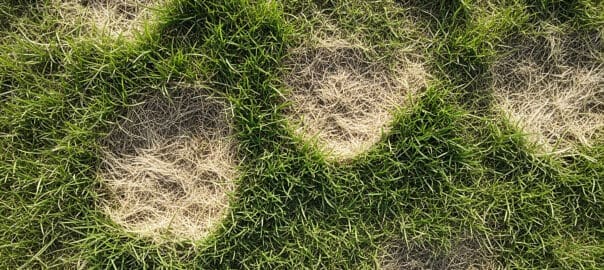
Dollar spot control has become one of the most pressing challenges in professional turfgrass management, and the window for reliable, repeatable results is narrowing fast.
If you are managing bentgrass greens, ryegrass fairways, or bluegrass roughs under peak summer disease pressure, you already know the signs. Small, bleached, straw-colored spots on individual leaf blades. Reddish brown lesions with a tan center crossing the leaf tissue. Mycelium visible in the early morning after heavy dews. And fungicide programs that used to work reliably now deliver inconsistent results.
Dollar spot caused by Clarireedia jacksonii (formerly classified as Sclerotinia homoeocarpa) is widely regarded as the most economically significant turfgrass disease in the United States. The challenge is no longer simply identifying and treating it. The real challenge is managing dollar spot issues in a way that still works next season and the season after that.
This is where chitosan technology changes the conversation.
Why Does Dollar Spot Keep Coming Back?
The environmental triggers for dollar spot are predictable and, for most golf course and professional turf environments, unavoidable.
The pathogen population thrives when daytime temperatures range between 59 and 86 degrees Fahrenheit, particularly in warm-to-cool transition periods. Prolonged leaf wetness from heavy dews, poor air circulation, and high humidity give the fungus exactly what it needs to colonize. Nitrogen-stressed turf is significantly more vulnerable, and cool-season turfgrass species including creeping bentgrass, annual bluegrass, Kentucky bluegrass, and perennial ryegrass are among the most susceptible.
High-value playing surfaces compound the risk. Close mowing height, high traffic, and compaction already compromise plant health. When disease pressure arrives under those conditions, recovery is slower, and the visual impact on playing quality is immediate.
Research from Penn State University Extension confirms that dew removal through early morning mowing or rolling can meaningfully reduce infection cycles. But managing the cultural environment only takes you so far, and fungicide applications have long been the backbone of dollar spot suppression programs on golf courses and professional turf facilities.
The problem is that the pathogen has a documented and well-researched ability to develop resistance to the fungicide classes most commonly used against it.
How Does Fungicide Resistance Develop in Dollar Spot Pathogen Populations?
Resistance management is now a required part of every serious dollar spot program, and the science explains why.
Fungicide resistance develops when repeated applications of the same fungicide mode of action create selection pressure within the pathogen population. Susceptible strains are eliminated. Naturally occurring resistant strains survive, reproduce, and gradually become the dominant portion of the population. Once resistant strains represent a significant share of the pathogen population at a site, that fungicide mode of action loses its efficacy, sometimes permanently.
Dollar spot is particularly prone to this cycle. Research published in PLoS ONE and documented by Penn State Extension shows that Clarireedia spp. populations have demonstrated reduced sensitivity to benzimidazoles (FRAC Group 1) and demethylation inhibitors (DMIs, FRAC Group 3) in Pennsylvania and the surrounding region. Cross-resistance within the DMI group is a known concern, meaning resistance to one active ingredient within that group can confer partial resistance to others.
The Guelph Turfgrass Institute notes that fungicide resistance in dollar spot has been a persistent issue, and that multiple fungicides with different modes of action must be used in rotation. NC State University Extension guidance mirrors this, recommending that turf managers rotate among fungicide classes after each application and minimize total fungicide use through integrated management to prevent or delay the development of resistance to the fungicide.
SDHI fungicides (FRAC Group 7) and QoI fungicides (FRAC Group 11) are increasingly part of dollar spot rotation programs, but resistance to the fungicide within these classes has also been documented at target site mutations in the pathogen. The Fungicide Resistance Action Committee (FRAC) classification system exists specifically to help professionals structure rotation programs around different modes of action, reducing the probability that a single resistant strain can take over a population.
What fungicide labels consistently recommend, and what the resistance management science supports, is that no single selective fungicide should be applied repeatedly without rotation. The frequency and number of fungicide applications within a season matter significantly to resistance outcomes.
What Is Chitosan, and How Does It Support Turf Defense?
Chitosan is a naturally derived biopolymer produced from chitin, the structural component found in crustacean shells and fungal cell walls. It is a fungicide and was required to be registered with the U.S. EPA as such for many decades before being granted an EPA 25(b) exemption around 2020. Its value in disease pressure management comes both from its direct fungicidal activity and from what it does to the plant itself.
When chitosan is applied to turfgrass, it functions as a plant defense activator, stimulating the plant’s own immune response through a process known as induced systemic resistance. The plant’s signaling pathways recognize chitosan as a foreign molecule and trigger a cascade of defense reactions, including the production of pathogenesis-related proteins, increased synthesis of phenolic compounds, and the reinforcement of cell wall lignification that physically inhibits pathogen penetration.
This mechanism is distinct from how selective fungicides work. A fungicide targets the pathogen directly by blocking ergosterol biosynthesis, inhibiting respiration, or disrupting cell division at a specific target site. Chitosan works by making the host plant a harder target. Because chitosan does not act on a specific fungal target site, the pathogen population cannot develop resistance to it the way it does with conventional fungicide mode of action rotation failures.
Published research in plant immunity literature has documented chitosan’s ability to elicit salicylic acid and jasmonic acid signaling pathways, both key components of systemic acquired resistance in plant tissues. These pathways are well-established in turfgrass research on stress response and disease suppression.
For golf course superintendents managing dollar spot, this has practical implications. Including chitosan as part of a rotation program means at least some applications in your seasonal calendar are not relying on a selective fungicide mode of action at all, giving your existing fungicide chemistries a longer effective life.
How Does Nitrogen Status and Soil Health Affect Dollar Spot Vulnerability?
Nitrogen is directly tied to dollar spot vulnerability, and it is one of the most actionable variables in a turf manager’s control.
Low nitrogen availability weakens turfgrass and significantly increases susceptibility to Clarireedia jacksonii. NC State Extension research confirms that adequate and properly timed nitrogen fertility is one of the most effective cultural tools for suppressing dollar spot. Nitrogen-stressed turf has thinner cell walls, reduced carbohydrate reserves, and a weakened ability to mount an effective plant immunity response.
The Rhizosphere Is Your First Line of Defense
But fertility management does not stop at nitrogen. The biological health of the rhizosphere plays an equally important role. A diverse, well-populated rhizosphere consisting of beneficial bacterium, symbiotic fungal forms, protozoa, enzymes, polysaccharides, and other organic compounds forms the biological foundation for all turfgrass health. Research shows that most synthetic fertilizers and fungicides can negatively impact the bio-culture and root structure formations of turf grass. When that biological foundation is compromised, turfgrass loses the support systems that help it resist environmental stressors, including disease pressure.
What Do Humic and Fulvic Acids Actually Do?
Humic substances improve carbohydrate content and nutrient concentration in leaf blades and sheaths while under stress, enhance nutrient uptake, and reduce uptake of toxic elements. Under the influence of humic acids, plants grow stronger, resist plant diseases better, and maintain the cellular integrity needed to sustain a strong defense response. Fulvic acids work synergistically with fertility inputs to increase the permeability of plant cell membranes and accelerate the translocation of nutrients to the root zone, directly supporting the biological environment where disease suppression begins.
Why Silica Belongs in Your Summer Program
Silicon strengthens epidermal and hypodermal cell walls in turfgrass, creating a physical barrier that is harder for pathogens to penetrate. Research has shown silica supplementation supports turfgrass under biotic stress by improving cell wall rigidity and reducing the metabolic energy required for disease resistance. A targeted nitrogen formulation that includes silica addresses both the fertility and structural defense variables that make turfgrass vulnerable to dollar spot in a single application.
Seaweed and Amino Acids Complete the Picture
Turfgrasses treated with seaweed plus minimal levels of nitrogen show increased cytokinin levels in the root, which stimulate fibrous root mass development and create stronger collecting points for photosynthates and nutrients. Increased plant health and vigor allow turfgrass to better resist disease pathogen attack, and seaweed applications have a dose-dependent response, being more promotory at lower concentrations, which aligns naturally with the measured, strategic approach that resistance management programs require.
Amino acids also play a structural role in plant defense. L-amino acids improve cellular wall turgidity, permeability, and capacity, and help maintain cellular integrity during drought, salt, and heat stress conditions. These are precisely the conditions under which dollar spot pressure intensifies. When amino acid nutrition supports cellular integrity, the plant is better equipped to mount and sustain an immune response when chitosan signals the defense pathway.
What Does a Practical Seasonal Rotation Actually Look Like?
A practical resistance management program for dollar spot does not need to be complicated. It needs to be strategic. Your rotation should layer fungicide chemistries and biological tools intentionally across the season, with timing and sequencing doing as much work as the products themselves.
Here is what a sound rotation framework looks like in practice:
- Rotate among at least two or three fungicide modes of action throughout the season, with no consecutive applications from the same FRAC group
- Layer biological and plant defense tools between fungicide applications to reduce selection pressure on the pathogen population and strengthen plant health between spray intervals
- Position chitosan applications at pre-infection windows before peak disease pressure arrives, during extended periods of heavy dew and humidity, or as transition treatments between fungicide modes of action
- Prioritize summer as your highest-risk window, when heat stress, traffic, and close mowing height on golf course turf create compounding vulnerability for dollar spot
- Start supporting soil health and plant immunity before the disease pressure window opens, not after dollar spot appears
- Address thatch proactively throughout the season, as thatch provides harboring sites for dollar spot inoculum and a biologically active soil profile reduces those conditions through natural decomposition activity
Bio-induced disease suppression through an active rhizosphere is not a replacement for a structured fungicide rotation, but it is a force multiplier that improves the performance of every tool in your program.
Are Biological Tools Enough on Their Own?
Used in isolation, no biological program replaces a well-structured fungicide rotation when active dollar spot pressure is present. That is not the claim.
The value of chitosan technology and biological inputs is in what they add to an integrated approach, reducing fungicide applications without sacrificing dollar spot control outcomes, extending the effective life of your fungicide chemistries, and supporting the plant health and soil conditions that reduce base-level disease pressure throughout the season.
Professionals who have integrated plant defense activators and soil biology tools into their programs report more consistent turf performance across the full season, not just in the weeks immediately following fungicide applications.
The goal of any serious resistance management program is to reduce the number of times you need to apply selective fungicides to achieve acceptable control. Chitosan works directly toward that goal.
Build a Smarter Program with BioPlex Organics
If you are ready to build a more strategic dollar spot control and fungicide resistance management program, BioPlex Organics has the tools to support your rotation from the biology up. BioPlex PATHOGEN Defense POWER+ anchors the chitosan side of your program, while BioPlex TURF POWER+ and BioPlex 808 GREEN POWER+ keep plant health strong when stress conditions peak. BioPlex 5M BioBUILDER N 10-0-0 plus 10% Silica delivers targeted nitrogen and silica in a single application, and BioPlex FULVIC POWER+ supports the nutrient uptake and cellular integrity that make every other input work harder.
These products are designed to work as a system, for professionals who understand that long-term dollar spot control starts at the plant and soil level, not just at the spray nozzle. BioPlex 3 D-THATCHER BIOLOGY rounds out the program by supporting the active microbial community that suppresses inoculum and builds a healthier rhizosphere season after season. Shop for your dollar spot solution now.
SOURCES
- Penn State University Extension. “Turfgrass Diseases: Dollar Spot (Causal Fungus: Clarireedia jacksonii).”
https://extension.psu.edu/turfgrass-diseases-dollar-spot-causal-fungus-clarireedia-jacksonii/ - NC State University Extension. “Dollar Spot in Turf.”
https://content.ces.ncsu.edu/dollar-spot-in-turf - Guelph Turfgrass Institute. “Dollar Spot Disease Fact Sheet.” University of Guelph.
https://guelphturfgrass.ca/sites/default/files/documents/gti_fact_sheet-dollarspot-aoda.pdf - University of Maryland Extension. “Turfgrass Diseases: Dollar Spot.” FS-2023-0665.
https://extension.umd.edu/sites/extension.umd.edu/files/publications/Turfgrass-Diseases-DollarSpot_FS-2023-0665_ada.pdf - Oliveira, M.T., et al. “Sensitivity of Clarireedia spp. to benzimidazoles and dimethyl inhibitors.” PLoS ONE, 2023.
https://pmc.ncbi.nlm.nih.gov/articles/PMC10288879/ - GCM Online. “Dollar Spot Fungicide Resistance.”
https://gcmonline.com/course/environment/news/dollar-spot-fungicide-resistance - Fungicide Resistance Action Committee (FRAC). FRAC Code List.
https://www.frac.info/ - Iriti, M., and Faoro, F. “Chitosan as a MAMP, searching for a PRR.” Plant Signaling and Behavior, 2009.
https://doi.org/10.4161/psb.4.1.7408 - Rabea, E.I., et al. “Chitosan as Antimicrobial Agent: Applications and Mode of Action.” Biomacromolecules, 2003.
https://doi.org/10.1021/bm034130m - Yin, H., et al. “Chitosan oligosaccharides trigger innate immunity responses in rice.” Plant Journal, 2010.
DOI: 10.1111/j.1365-313X.2010.04344.x - Pacific Northwest Pest Management Handbooks. “Lawn and Turf: Dollar Spot.” Oregon State University.
https://pnwhandbooks.org/node/2988/print - USDA Agricultural Research Service. “Dollar Spot Control Research.”
https://www.ars.usda.gov/research/project/?accnNo=437045 - BioPlex Organics Internal Documentation: Golf Course Sustainable Bio-Nutrition. BioPlex Organics, 1987–present.
- BioPlex Organics Internal Documentation: Humic Affects on Plants and Soils. BioPlex Organics, 1987–present.
- BioPlex Organics Internal Documentation: Seaweed: One of Nature’s Best Kept Sea-crets. BioPlex Organics, 1987–present.
- BioPlex Organics Internal Documentation: L-Amino Acid Complex: Plant Life Fundamental Building Blocks. BioPlex Organics, 1987–present.
- BioPlex Organics Internal Documentation: General Product Use and Application Index. BioPlex Organics, 1987–present.
